




Automotive

Seamless integration. Measurable gains.
Edge Automation designs and integrates custom systems for automotive manufacturing—built to remove bottlenecks, stabilize quality, and improve safety without sacrificing flexibility.
Why Automotive Facilities Choose Edge
- Engineered to Hit Takt Time – Every Shift
Our systems are designed around your cycle-time requirements, eliminating throughput gaps that erode capacity without requiring additional floor space. - Precision Built
We engineer quality directly into the process — so accuracy is repeatable at full speed and defects are caught. - Fast Changeover. Real Flexibility
Our systems handle increasing SKU complexity and product mix changes with tooling and architecture designed for rapid transitions, not rip-and-replace. - Safer Work, Stronger Workforce
Our automation keeps workers out of high-injury tasks without taking them off the line — improving safety outcomes while preserving your capacity to scale. - One Integration Partner. Full Line Visibility
We design and integrate the full system — giving you a single point of accountability, clear performance visibility, and a line built to grow.
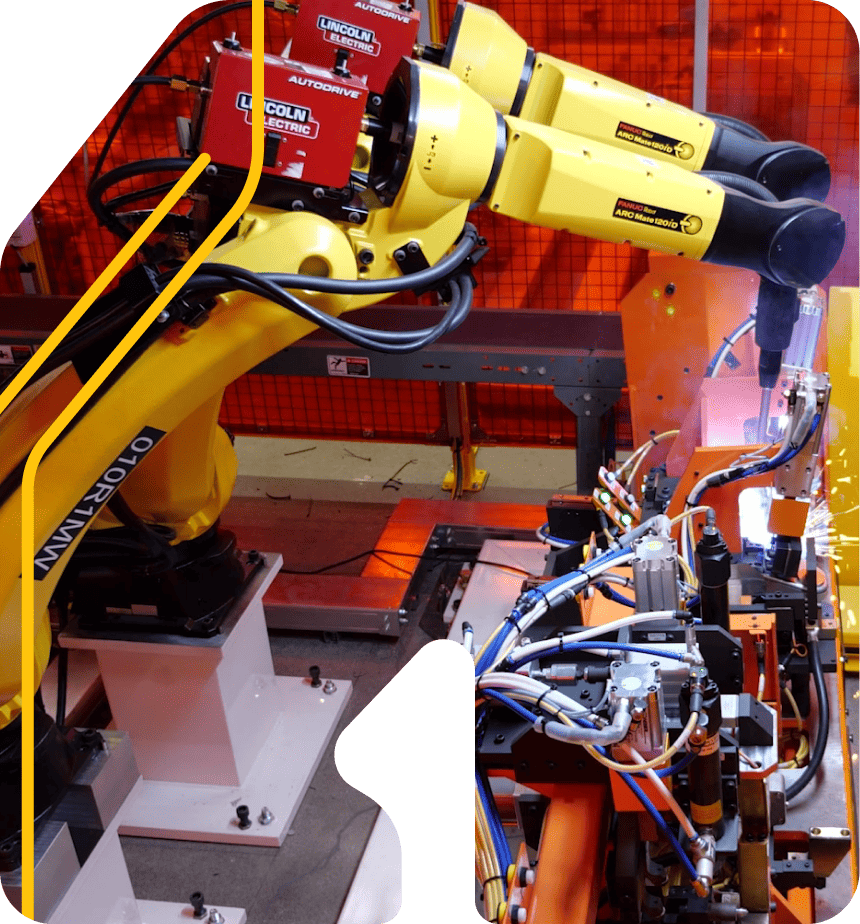
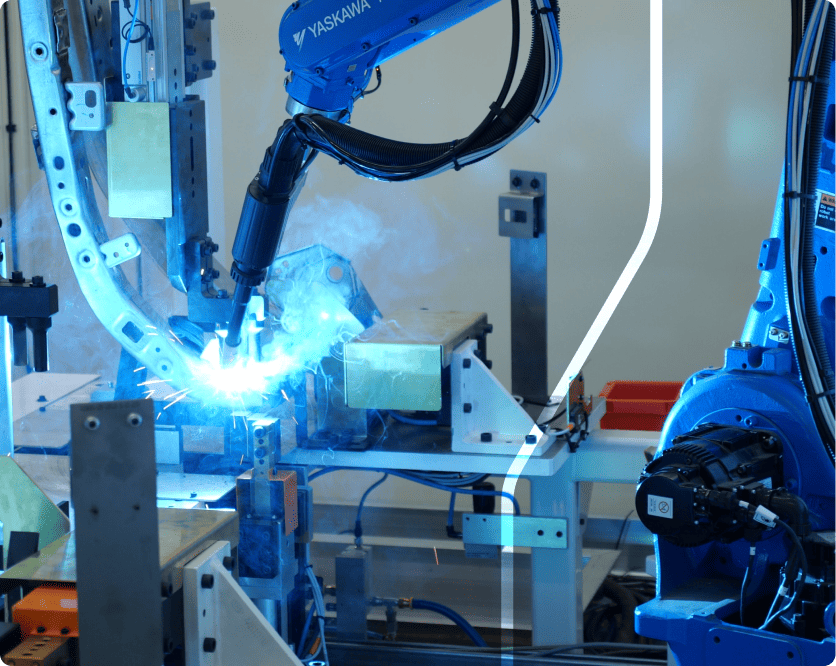
Automation Solutions for Automotive Manufacturing
- Assembly automation: Robotic/cobot fastening, pressing, and clipping.
- Material handling: AGVs/AMRs, conveyors, and part feeding.
- Welding & joining: MIG/TIG, spot, laser, and riveting/clinching.
- Quality & inspection: Vision, functional, leak, and CMM/gauging.
- Paint & sealing: Robotic sealant, underbody.
- Flexible systems: Quick-change tooling, reconfigurable fixtures.
- EV automation: Battery assembly, laser tab welding.
Examples of Our Successes
From robotic cells to multi-station lines, we deliver solutions that meet real production targets for your process: cycle time, uptime, and traceability.

Automated Overmolding Cell
This overmolding process relied on manual insert loading, causing placement variability that led to misloads, scrap, inconsistent part quality, and increased safety risk near the injection molding press.
Our team designed and developed a robot-driven, overmolding cell to integrate with the injection moulding press, using PLC-controlled sequencing, press handshake logic, tray handling, and vision/presence sensing to automatically load verified inserts and unload finished parts.
- Improved operator safety by eliminating manual insert loading at the mold press.
- Lowered misloads and scrap using poka‑yoke verification (vision + presence sensing).
- Achieved consistent cycle time synchronized to the injection molding press.
- Improved part quality and repeatability with precise, robot-controlled insert placement.
- Enabled reduced-operator / lights-out capability for higher utilization and uptime.
- Reduced labour content through robotic loading/unloading and automatic tray handling.
This overmolding process relied on manual insert loading, causing placement variability that led to misloads, scrap, inconsistent part quality, and increased safety risk near the injection molding press.
Our team designed and developed a robot-driven, overmolding cell to integrate with the injection moulding press, using PLC-controlled sequencing, press handshake logic, tray handling, and vision/presence sensing to automatically load verified inserts and unload finished parts.
- Improved operator safety by eliminating manual insert loading at the mold press.
- Lowered misloads and scrap using poka‑yoke verification (vision + presence sensing).
- Achieved consistent cycle time synchronized to the injection molding press.
- Improved part quality and repeatability with precise, robot-controlled insert placement.
- Enabled reduced-operator / lights-out capability for higher utilization and uptime.
- Reduced labour content through robotic loading/unloading and automatic tray handling.
Automated Assembly Line
Automated assembly and ultrasonic welding of automotive interior panels, combining a molded plastic substrate with die-cut insulation. This process required precise material placement and bonding, with challenges around manual handling, insulation consistency, and weld quality verification.
Our expert team designed and built a modular palletized assembly line with multiple automated and semi-automated stations.
- Balanced cycle time across stations → stable output and predictable scheduling.
- Higher first-pass yield via poka-yoke + automated verification.
- Reduced labour content by converting manual steps into semi/fully automated stations.
- Full part traceability to meet automotive quality and compliance requirements.
- Increased throughput and efficiency by removing bottlenecks and synchronizing flow.
- Scalable platform enabling future station additions and process changes with minimal disruption.
Automated assembly and ultrasonic welding of automotive interior panels, combining a molded plastic substrate with die-cut insulation. This process required precise material placement and bonding, with challenges around manual handling, insulation consistency, and weld quality verification.
Our expert team designed and built a modular palletized assembly line with multiple automated and semi-automated stations.
- Balanced cycle time across stations → stable output and predictable scheduling.
- Higher first-pass yield via poka-yoke + automated verification.
- Reduced labour content by converting manual steps into semi/fully automated stations.
- Full part traceability to meet automotive quality and compliance requirements.
- Increased throughput and efficiency by removing bottlenecks and synchronizing flow.
- Scalable platform enabling future station additions and process changes with minimal disruption.
Cutting & Assembly Cell
An automotive interior panel process needed repeatable insulation placement, verified ultrasonic weld quality, and synchronized material flow from an overhead conveyor—requirements that were difficult to achieve with manual handling and limited in-process verification.
A robotic production cell was engineered to receive panels from an overhead conveyor, die-cut insulation (120-ton) in-house, robotically place and verify materials, and execute ultrasonic welding on an indexed dial table—fully sequenced by PLC/HMI with barcode/vision-based traceability and integrated safety.
- Achieved 30-second cycle time per completed panel.
- Eliminated external insulation dependency by integrating in-house Thinsulate cutting and handling.
- Improved assembly consistency through robotic placement + vision verification (reduced alignment and handling variation).
- Enabled full traceability (“birth certificate”) linking barcode, vision images, and weld data per part.
- Reduced manual handling and improved ergonomics, limiting the operator role to unload/inspection.
An automotive interior panel process needed repeatable insulation placement, verified ultrasonic weld quality, and synchronized material flow from an overhead conveyor—requirements that were difficult to achieve with manual handling and limited in-process verification.
A robotic production cell was engineered to receive panels from an overhead conveyor, die-cut insulation (120-ton) in-house, robotically place and verify materials, and execute ultrasonic welding on an indexed dial table—fully sequenced by PLC/HMI with barcode/vision-based traceability and integrated safety.
- Achieved 30-second cycle time per completed panel.
- Eliminated external insulation dependency by integrating in-house Thinsulate cutting and handling.
- Improved assembly consistency through robotic placement + vision verification (reduced alignment and handling variation).
- Enabled full traceability (“birth certificate”) linking barcode, vision images, and weld data per part.
- Reduced manual handling and improved ergonomics, limiting the operator role to unload/inspection.
Seeking Automation Solutions That Work?
We’ll help you identify the highest-impact automation opportunities and map a path that reduces risk—whether it’s a single cell, a line retrofit, or a full new build.